

How To Use An HTTP Redirect Checker To Confirm Your HTTPS Switch
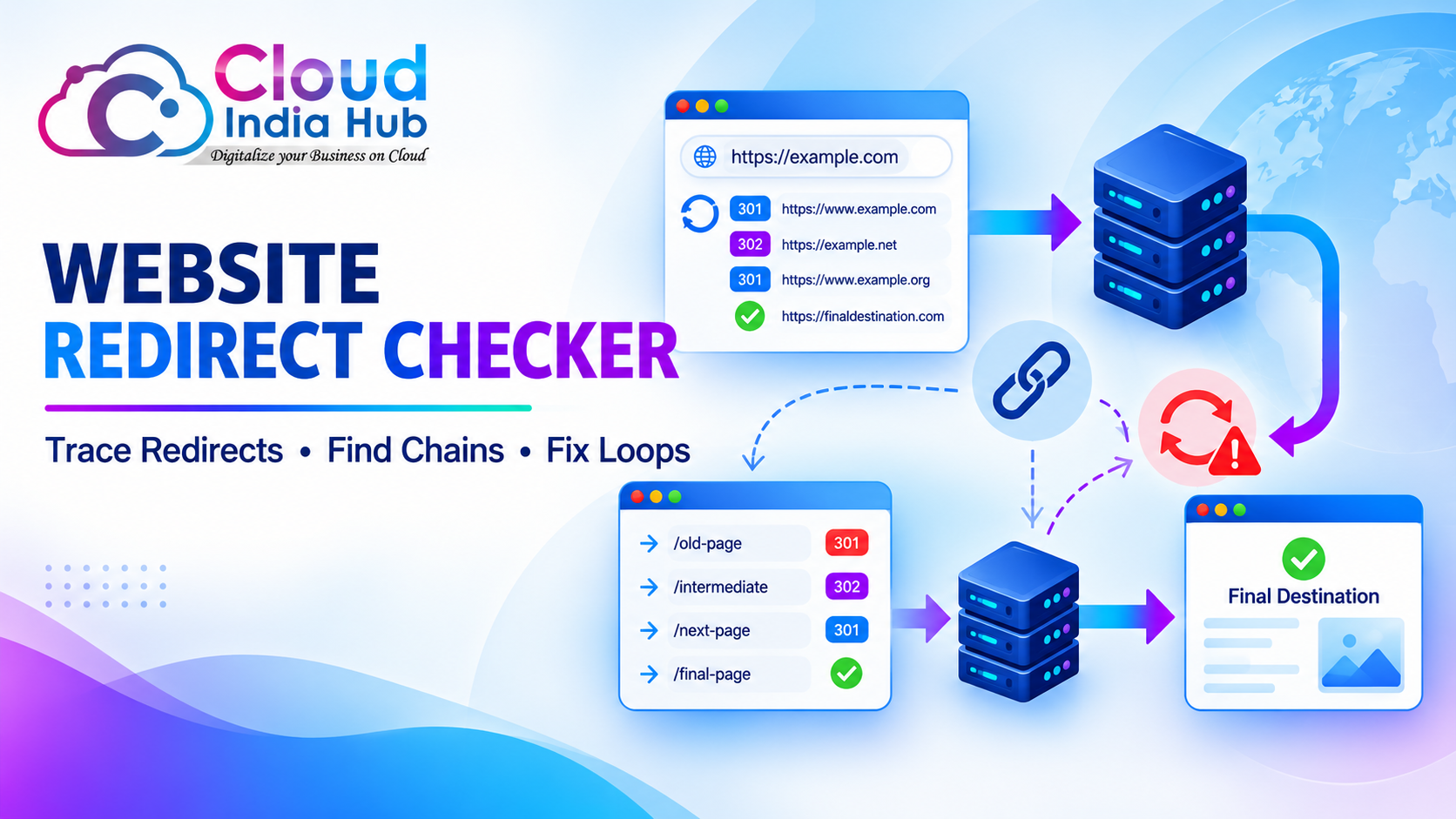
An HTTP redirect checker requests your address over plain http:// and lists every hop and status code until the final page loads. A healthy HTTPS upgrade takes exactly 1 hop, a 301 from http:// to https://, then a 200 response.
A broken upgrade rarely stops the page from opening, so most owners never notice it. If you want the complete hop-by-hop method first, read our guide to tracing every redirect hop. This post covers one job: proving that the insecure version of your site always lands on the secure one.
At A Glance
• Price: Shared hosting from ₹239 per month on a 1-year term, plus GST
• Included: Free SSL certificate on shared hosting plans
• Support: 24x7 chat with the Cloud India Hub team
• Ideal result: One 301 hop from http to https, then a 200 page
• Test four address versions: http and https, with and without www
What Does An HTTP Redirect Checker Show For Your Domain?
An HTTP redirect checker sends a request to the address you enter, reads the status code and Location header in the reply, then follows each hop to the end. The report lists every step in order, so you can see exactly where a visitor lands.
Start from the http:// address on purpose. Some browsers jump straight to https when you type a bare domain, which hides the very hop you want to inspect. A checker has no such shortcut, so it records what a first-time visitor or a crawler really receives.
Watch the scheme and the host together. A good upgrade changes both in one hop, for example from http://www to https://acmeshop.in. If the scheme changes in one hop and the host changes in the next, you have a chain of two, even though every step looks correct on its own.
A clean HTTPS result shows four things:
• The first request returns a redirect code, not a normal page
• The Location header names an https:// address on your preferred host
• The next request returns 200 OK
• The whole trip adds no extra hops
Which Status Codes Should Your HTTPS Upgrade Return?
Your upgrade should answer the http:// request with a 301 or 308, then return a 200 on the https:// page. Google Search Central lists 301 and 308 as permanent redirects, which tells it to show the secure address in results.
When you check your redirects and statuscode together, the second column matters as much as the first. A 200 on the last row proves the destination works. A 302 or 307 on the first row means the move was labelled temporary, so the old address may stay in results.
Temporary codes are easy to leave behind. Some tools and panels default to them, and Google notes that a temporary redirect keeps the source page in search results. After an SSL switch, that can leave your http:// address visible long after you meant to retire it.
Use the table below when your HTTP redirect checker returns something unexpected.
|
What you see on the http:// request |
What it means |
What to do |
|
301, then 200 on https |
Healthy upgrade |
Nothing, retest after future changes |
|
302 or 307, then 200 |
Move labelled temporary |
Change the rule to a permanent code |
|
200 straight away on http |
No redirect exists |
Add a redirect rule |
|
301, then another 301 |
A chain of two hops |
Point the first rule at the final address |
|
The same 301 repeating |
A loop |
Remove the duplicate rule |
|
404 or 5xx at the end |
A broken destination |
Fix the page or server first |
Do You Need An SSL Certificate Before You Redirect To HTTPS?
Yes. A redirect to https:// only works when a valid certificate covers the address visitors land on. Without one, browsers show a security warning before the page loads, so the redirect traps visitors instead of helping them.
Cloud India Hub lists a free SSL certificate on its shared hosting plans, with the Starter plan from ₹239 per month on a 1-year term, plus GST. Confirm the certificate is active before you add any rule.
Check coverage as well as presence. The certificate should include:
• Your bare domain
• The www host, if you use it
• Any subdomain you plan to redirect
Any http to https redirect checker will expose a certificate that covers only one of these names, because the browser warning appears at the hop where the mismatch occurs. Fix the certificate first, then the rule.
How Do You Check HTTP Redirect Results For All Four URL Versions?
To check http redirect behaviour properly, test four addresses: http and https, each with and without www. Every one of them should reach a single final address in one hop or fewer, so visitors never pass through a middle step.
|
Address you test |
Expected result |
|
http://acmeshop.in |
One 301 to your final https address |
|
http://www.acmeshop.in |
One 301 to the same final address, not two |
|
https://acmeshop.in |
200, or one 301 to www if www is your choice |
|
https://www.acmeshop.in |
200, or one 301 to the bare domain |
Choose one preferred address and send the other three to it. Google advises picking a single canonical destination rather than letting several versions answer.
If the www version returns a connection error instead of a status code, the cause is usually a missing DNS record, not a redirect rule. Our DNS settings guide shows how to check the A and CNAME entries. An HTTP redirect checker cannot follow a hop that never resolves.
A www address usually fails for one of three reasons:
• No DNS record exists for the www name
• The record still points at an old server
• The certificate was issued for the bare domain only
Test each in that order, because a DNS fault hides the other two.
Where Does The HTTPS Redirect Rule Actually Live?
The rule lives in one of four layers: your server configuration, your hosting panel, your CMS settings, or a CDN. Fix it in the layer that created it, because editing the wrong one changes nothing and hides the real cause.
• Server file: on Apache, redirect rules usually sit in .htaccess
• Hosting panel: some panels offer a force-HTTPS switch
• CMS: the site address setting may still say http
• CDN or proxy: a front layer can add its own redirect
Domain forwarding is a fifth place a redirect can start. Cloud India Hub lists forwarding among the features that come with a domain, so check that panel too if the Location header names a different domain than you expected. Ask your host which layer enforces HTTPS before you touch any file.
If your plan includes cPanel, open File Manager, click Settings, and tick Show Hidden Files so .htaccess appears. Copy the file before you edit it. A typical Apache rule looks like this:
RewriteEngine On
RewriteCond %{HTTPS} off
RewriteRule ^(.*)$ https://%{HTTP_HOST}%{REQUEST_URI}
[L,R=301]
Use one method only. A panel switch and a hand-written rule both active at once is a common start to trouble.
Why Do Redirect Loops And Chains Appear After The Switch?
Loops and chains appear when two layers each try to enforce HTTPS or a preferred host. One rule sends the visitor to https, another sends them to www, and a third sends them elsewhere, so the browser makes extra trips or gives up with a too many redirects error.
The usual causes are easy to list:
• A server rule and a plugin rule are both switched on
• The CMS address still says http while the server forces https
• A CDN reaches your server over http, and the server redirects every request back
• Rules copied from an older host duplicate new ones
Once you find the clash, remove one of the two rules. Our walkthrough on fixing chains with a URL redirect checker covers the cleanup for longer paths. Then retest all four address versions, because one fix can expose another.
How Do You Run An HTTP Redirect Test In Six Steps?
Begin at the http:// address, record every hop, and change one rule at a time. This routine with an HTTP redirect checker works for a single home page or a short list of your busiest landing pages.
1. Open a private browser window so a cached redirect cannot mislead you.
2. Enter the http:// version of your home page in the checker.
3. Note the first status code and the address in the Location header.
4. Count the hops, then confirm the last row returns 200.
5. Repeat for the www version and two or three inner pages.
6. Fix the layer that created any extra hop, then retest from step 1.
Save each result with the date. A before and after record proves the fix worked and gives you something to compare if a rule misbehaves later.
Frequently Asked Questions
Is An HTTP Redirect Checker Free To Use?
Yes. Most online tools check one address at no cost, and an HTTP redirect checker usually charges only for bulk lists or monitoring, while browser developer tools are free too.
Should An HTTP To HTTPS Redirect Be A 301 Or A 302?
Use a 301, or a 308 if the request method must be kept. The move to HTTPS is permanent, and permanent codes tell Google to show the secure address.
Why Does My Browser Still Show The Old Redirect After I Fixed It?
Browsers can cache permanent redirects. Test in a private window, clear the cache, or use a checker that makes a fresh request every time.
What Does A Redirect Loop Error Mean?
Two rules are sending the visitor back and forth until the browser gives up and shows an error. Find both rules and keep only one.
Do I Need To Redirect Both www And Non-www?
Choose one as your preferred address, then redirect the other to it. Both should end on the same final https page in a single hop.
Will An HTTPS Redirect Slow My Website?
A redirect adds one extra request on the first http visit, so keep it to a single hop. Chains of two or three hops are the real cause of delay.
Where Do You Go From Here?
Run your next HTTP redirect checker test on the http:// version of your home page today, and note the hop count. If the rule sits in a panel or file you cannot reach, ask the Cloud India Hub support team, where chat runs 24x7.
Expert advice
|
Learn how an HTTP redirect checker proves your http:// pages land on https:// in one hop, which status codes to expect, and how to fix loops after an SSL switch. |
Serving Bengaluru, Karnataka.



































































































































































































































Leave A Comment